
Compress Image to 100KB
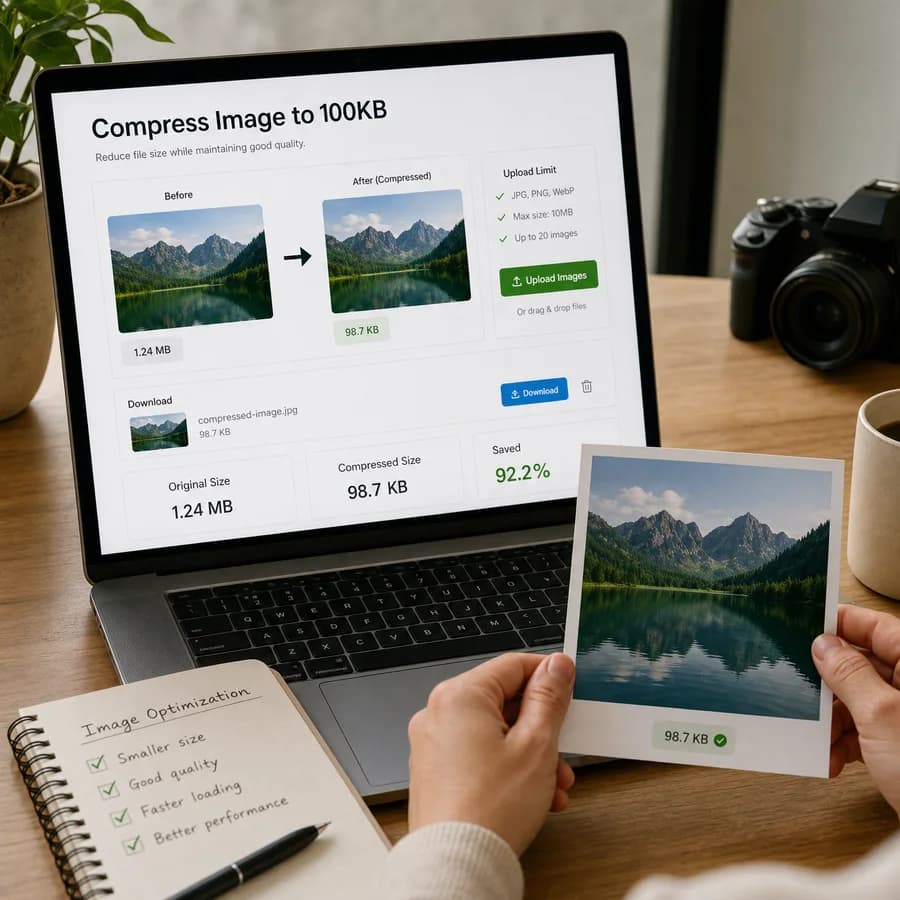
Compress Image to 100KB helps create a smaller JPG or WebP copy for upload forms, email, social previews, web pages, and document portals.
Reduce image size to 100KB online by letting the browser adjust quality and dimensions, then download the clearest output that fits the target when possible.
Supported image types
Target-size compression accepts common browser-decodable image files and exports a smaller JPEG or WebP copy. Animated images are treated as a single decoded frame by browser image decoding.
Choose an image for 100 KB
JPG, JPEG, PNG, WebP, and AVIF images up to 50 MB.
Compression result
Target match, output size, dimensions, and download.
100KB Image Compression Guide
What a 100 KB image target means
A 100 KB image target is a practical middle ground for upload portals, email-friendly photos, lightweight web pages, profile images, and document systems that reject large files. Compared with 50 KB, it usually gives more room for facial detail, product texture, and readable document edges.
This tool works locally in the browser. It decodes the selected image, tries JPEG or WebP output, searches quality settings, and scales dimensions down when quality alone cannot hit 100 KB. The output is a new compressed copy; the original file is not uploaded or modified.
- Use JPEG when a form or portal expects JPG/JPEG files.
- Use WebP when the destination accepts modern images and smaller output matters.
- 100 KB often preserves more usable detail than stricter 20 KB or 50 KB targets.
- Transparent PNGs exported as JPEG get a white background; choose WebP when transparency matters.
How to get the clearest 100 KB result
The tool balances output quality and dimensions. It first searches compression quality, then tries smaller dimensions when the image is too detailed for the target. A large phone image can often stay visually clear at 100 KB if the final pixel dimensions are reasonable for the upload destination.
If the closest output is still above 100 KB, crop away unneeded background, choose WebP, or start from a smaller image. If the result looks too soft, try a less strict target if your destination allows it.
- Use WebP for web pages, previews, and modern CMS uploads when accepted.
- Use JPEG for official portals that reject WebP files.
- Crop or resize very large camera photos before aiming for 100 KB.
- Keep the original file if you may need a higher-quality export later.
Privacy and browser limits
Browser-local compression avoids uploading sensitive images to a server. The file is decoded, drawn to a canvas, encoded as JPEG or WebP, and offered as a local download. Canvas export normally strips original camera metadata because the browser creates a fresh image file.
Browser support and memory limits still matter. Very large images may fail on older devices, and some browsers may not decode AVIF or encode WebP in every environment. If a format is not supported by your browser, use JPEG output or convert the file first.
- The compression result depends on browser image decoding and canvas encoding.
- Canvas export is lossy for JPEG and WebP because it changes quality and sometimes dimensions.
- Animated images are decoded as a still image, not preserved as animation.
- The tool counts only successful under-target outputs as paid/free tool uses.