
Flip Image Horizontal/Vertical
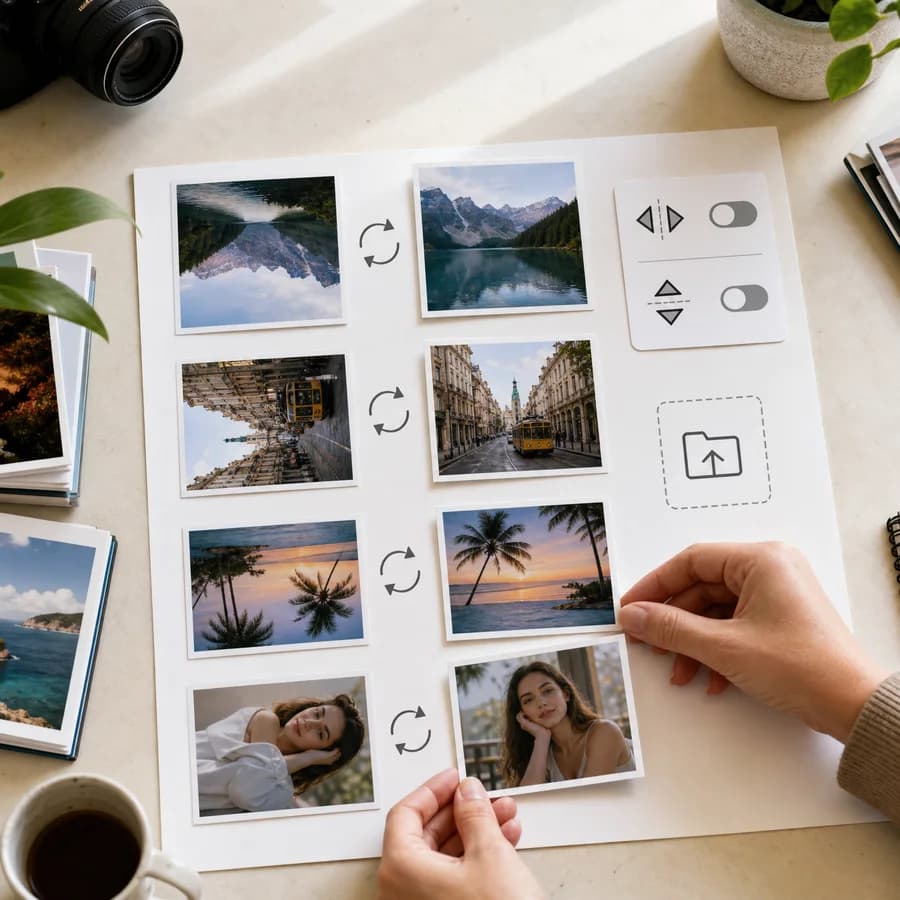
Flip Image Horizontal/Vertical mirrors photos, screenshots, and graphics left-to-right or top-to-bottom without uploading the file.
Mirror image online by choosing an image, selecting horizontal flip, vertical flip, or both, picking JPG, PNG, or WebP output, and downloading the flipped file.
Supported image types
The tool mirrors browser-decodable still images and exports a new JPEG, PNG, or WebP file. Animated images are treated as a single decoded frame by browser image decoding.
Choose an image and flip
JPG, JPEG, JFIF, PNG, WebP, AVIF, and BMP images up to 50 MB.
Mirror left to right across the vertical axis.
Best for screenshots, text, graphics, and transparency.
Flip result
Output preview, dimensions, format, and download.
Image Flip And Mirror Guide
When to flip an image horizontally or vertically
Horizontal image flip mirrors the picture left-to-right, which is useful for selfies, reversed product shots, scanned negatives, design mockups, and social previews where direction matters. Vertical image flip mirrors top-to-bottom, which is useful for upside-down scans, reflection-style graphics, texture work, and correcting images that were mirrored along the wrong axis.
This tool creates a new image with the pixels physically flipped. The downloaded file does not depend on hidden orientation metadata or a viewer-specific mirror setting.
- Use horizontal flip to swap left and right sides of a photo or graphic.
- Use vertical flip to swap top and bottom sides of an image.
- Use both when the image needs both mirror axes in one export.
- Use PNG output for screenshots, graphics, transparency, or text-heavy images.
How browser-local mirror export works
The selected file is decoded locally by the browser, drawn to a canvas with the selected mirror transform, and exported as a new JPG, PNG, or WebP file. The original file is not uploaded to a server and is not modified on your device.
A flip keeps the same pixel width and height because the image is mirrored in place. The result is a fresh raster export, so browser canvas output normally strips original camera metadata, GPS tags, and editor-specific metadata.
- JPG and JPEG input default to JPEG output for broad compatibility.
- PNG and BMP input default to PNG output for sharp graphics and text.
- WebP input defaults to WebP output when browser encoding supports it.
- AVIF can be flipped only when the browser can decode it through image APIs.
Choosing the output format
JPEG is usually the practical choice for ordinary photos because it works almost everywhere and keeps photographic files smaller than PNG. PNG is better for screenshots, transparent graphics, diagrams, logos, and images with sharp text. WebP is useful for modern websites and CMS workflows when the destination accepts it.
If the image has transparency and you choose JPEG, transparent pixels are drawn over a white background because JPEG does not support alpha transparency. Choose PNG or WebP when transparent areas must remain transparent.
- Choose JPEG for photos, profile pictures, marketplace uploads, and broad compatibility.
- Choose PNG for screenshots, scans, UI captures, transparency, and crisp text.
- Choose WebP for web pages and modern CMS workflows when accepted.
- Keep the original file if you need untouched metadata or exact archival quality.
Limits to know before downloading
Canvas-based flipping is fast and practical for common still images, but it still depends on browser image decoding and memory limits. Very large camera images can fail on older phones or low-memory browsers, and animated image formats are treated as a single decoded frame rather than preserved as animation.
Because the output is newly encoded, file size can change even when the intended edit is only a mirror flip. For strict upload limits, flip first, then use a compressor or target-size tool on the flipped output.
- The tool counts only successful flipped downloads as value-producing uses.
- Animated images are not preserved as animation.
- Metadata may be removed by the fresh canvas export.
- For print or archive workflows, inspect dimensions and output format before replacing the original.