
HTML Entity Encoder and Decoder vs JSONLint
HTML Entity Encoder and Decoder is the baseline in this comparison: HTML Entity Encoder and Decoder runs locally in your browser and returns copy-ready, testable output for developers, SEO teams, API testers, and content operators.
Compare HTML Entity Encoder and Decoder with JSONLint for local utility work versus strict JSON validation and formatting.
Quick verdict
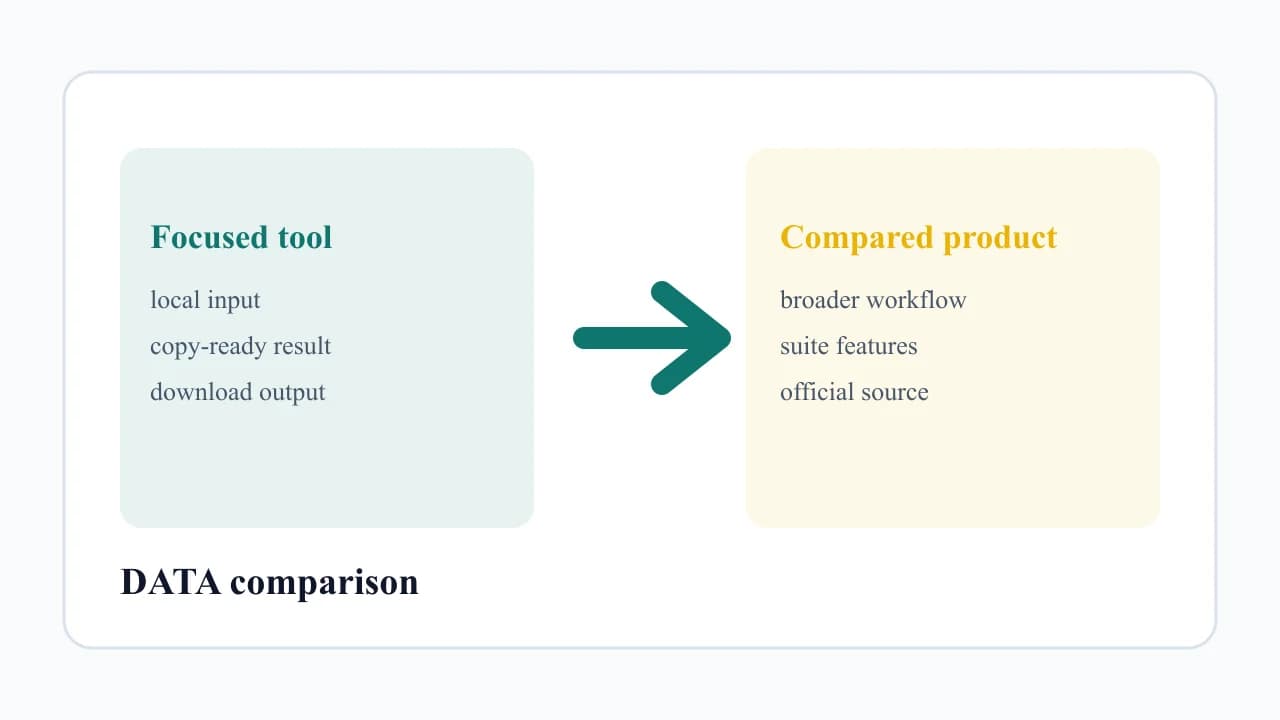
HTML Entity Encoder and Decoder is better for a focused local browser result; JSONLint is stronger when users want its wider product workflow.
How HTML Entity Encoder and Decoder fits
HTML Entity Encoder and Decoder focuses on html entity encoder and decoder helps developers, seo teams, api testers, and content operators format, validate, compare, encode, decode, or convert structured text locally in the browser with copy-ready results, clear downloads, and deterministic validation.
How JSONLint fits
JSONLint is a JSON validator focused on strict JSON validation and formatting.
Side-by-side comparison
| Decision point | HTML Entity Encoder and Decoder | JSONLint | Takeaway |
|---|---|---|---|
| Primary job | Our workflowHTML Entity Encoder and Decoder | Competitor workflowstrict JSON validation and formatting | Choose the narrower tool when the task is already known. |
| Processing model | Our workflowBrowser-local for supported inputs | Competitor workflowProduct-specific workflow | Local processing is simpler for sensitive one-off files. |
| Result style | Our workflowCopy-ready labels and generated downloads | Competitor workflowSuite-oriented output | The best fit depends on whether users need one answer or a platform. |
| Setup | Our workflowOpen the page and run the tool | Competitor workflowMay involve account, upload, app, or larger UI | Low setup matters for quick tasks. |
| Validation | Our workflowDeterministic checks and testable output | Competitor workflowDepends on product feature path | Objective output is easier to automate. |
| Best use | Our workflowSingle-purpose utility work | Competitor workflowJSON validator | Neither tool needs to cover the other's whole surface. |
Use HTML Entity Encoder and Decoder when
- quick one-off browser-local checks
- copy-ready labeled results
- deterministic output that can be validated without subjective review
Use JSONLint when
- teams already using JSONLint
- workflows needing strict JSON validation and formatting
- users who prefer a larger suite over a focused single page
Detailed comparison
Workflow fit
HTML Entity Encoder and Decoder is narrow and direct: the user gives it one clear input, gets labeled output, and can copy or download the result without navigating a larger suite.
Privacy posture
The TextFaker workflow keeps processing in the browser for the supported input, while JSONLint is usually a broader product or hosted tool with its own account, upload, or suite model.
Validation
HTML Entity Encoder and Decoder emphasizes deterministic output such as bytes, hashes, page counts, parsed fields, generated files, or formatted text that can be checked in tests.
When to choose each
Use HTML Entity Encoder and Decoder for a quick browser-local task. Use JSONLint when its wider strict JSON validation and formatting workflow is more important than a focused single-purpose result.
Research notes
- JSONLint is included because users often compare focused utilities against broader suites in this category.
- HTML Entity Encoder and Decoder should not claim complete feature parity with JSONLint.
- The comparison keeps outbound links only in the official source section rendered by the shared page.
Official source
The only outbound competitor link on this page is placed here for source checking after the comparison.
Official JSONLint source