
Perceptual Hash Generator vs OpenCV img_hash
Perceptual Hash Generator is the baseline in this comparison: Generate pHash-style, average hash, and difference hash fingerprints from an uploaded image locally in your browser.
OpenCV's img_hash module documents multiple image hashing algorithms, including perceptual hash variants for computer vision applications.
Quick verdict
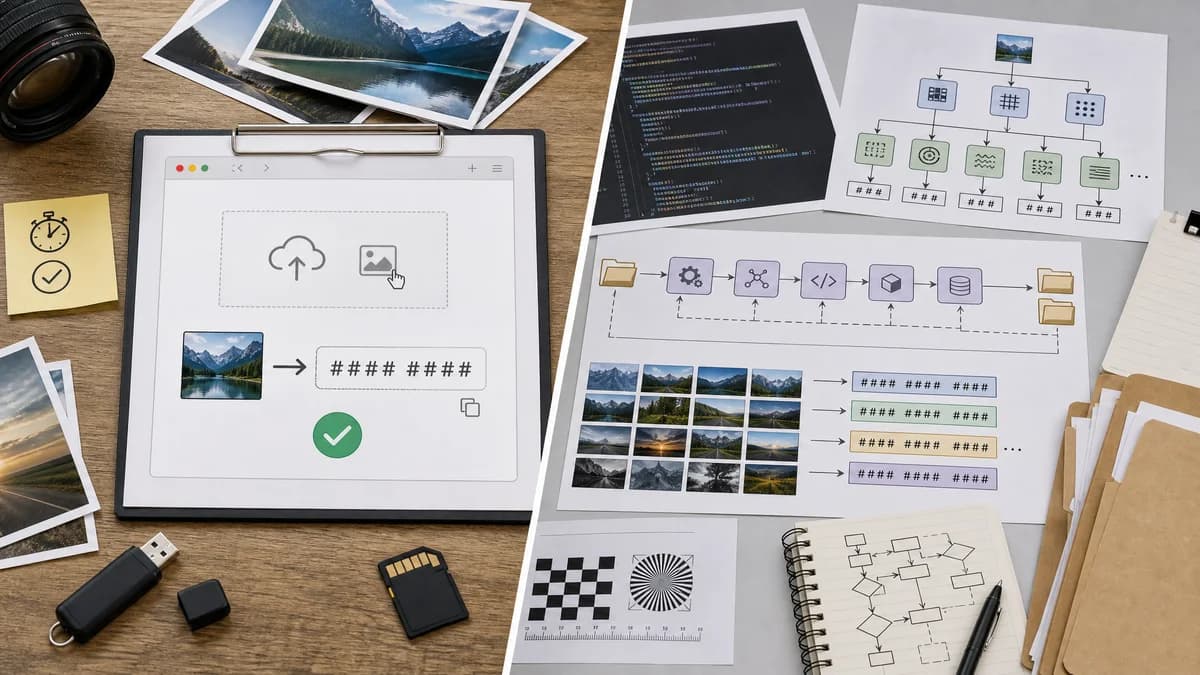
TextFaker is better for ad hoc image fingerprint generation; OpenCV is better for production computer vision pipelines and custom algorithm integration.
How Perceptual Hash Generator fits
TextFaker provides a no-install browser tool for users who do not need a full computer vision stack or server-side processing.
How OpenCV img_hash fits
OpenCV is a powerful developer library for programmatic image hashing and broader computer vision work, but it is not a copy-ready web generator for casual uploads.
Side-by-side comparison
| Decision point | Perceptual Hash Generator | OpenCV img_hash | Takeaway |
|---|---|---|---|
| Access model | Our workflowWeb tool, no install, browser-local upload. | Competitor workflowLibrary API requiring development environment integration. | TextFaker lowers friction for one-off use. |
| Algorithm breadth | Our workflowFocused on pHash-style, aHash, and dHash for common user intent. | Competitor workflowDocuments several hashing classes and algorithms. | OpenCV is broader, but TextFaker can be clearer for non-specialists. |
| Output UX | Our workflowHuman-readable hex/binary results with copy-all. | Competitor workflowProgrammatic API outputs for developers. | TextFaker prioritizes copy and interpretation. |
| Local processing | Our workflowRuns in the browser for a single uploaded image. | Competitor workflowRuns wherever OpenCV is installed, often server or local native environments. | Both can be local, but TextFaker avoids setup. |
| Comparison support | Our workflowIncludes Hamming-distance guidance in the UI. | Competitor workflowDeveloper docs expect users to handle comparison logic. | TextFaker explains the next step after generation. |
| Best scale | Our workflowSingle-image or small manual workflows. | Competitor workflowBatch and application-level computer vision workflows. | Do not position TextFaker as a batch indexing engine. |
Use Perceptual Hash Generator when
- One-off hash generation in a browser
- Users who cannot install native libraries
- Copy-ready output for tickets and QA notes
- Simple Hamming-distance education
Use OpenCV img_hash when
- Developers building computer vision pipelines
- Teams already using OpenCV
- Applications needing multiple low-level image hashing algorithms
- Batch processing with native performance
Detailed comparison
Developer Alternative
OpenCV is an open-source alternative for developers who need image hash algorithms inside code. It is not a direct UX competitor but matters for alternatives content.
Implementation Lesson
OpenCV's existence supports offering multiple hash families. TextFaker keeps the result set small enough to understand.
- Core set: pHash-style, aHash, dHash. Optional future set: color hash or wavelet hash only if clearly scoped.
Positioning
The comparison frames OpenCV as powerful but setup-heavy. TextFaker is for immediate browser use and copyable results.
Testing
Generated test images can validate behavior without relying on OpenCV. Cross-library equality is not promised unless explicitly verified.
Research notes
- Official library documentation source.
- Good open-source alternative for implementation-minded users.
- TextFaker does not claim OpenCV-equivalent algorithm coverage.
- Mention as adjacent/professional alternative in SEO content.
Official source
The only outbound competitor link on this page is placed here for source checking after the comparison.
Official OpenCV img_hash source