
Open Source Alternatives to TinEye MatchEngine
Perceptual Hash Generator is a browser-based alternative for users who need this focused result without installing a proprietary desktop app or entering a larger hosted workflow.
This research compares that workflow with TinEye MatchEngine while keeping the outbound source link at the bottom after the analysis.
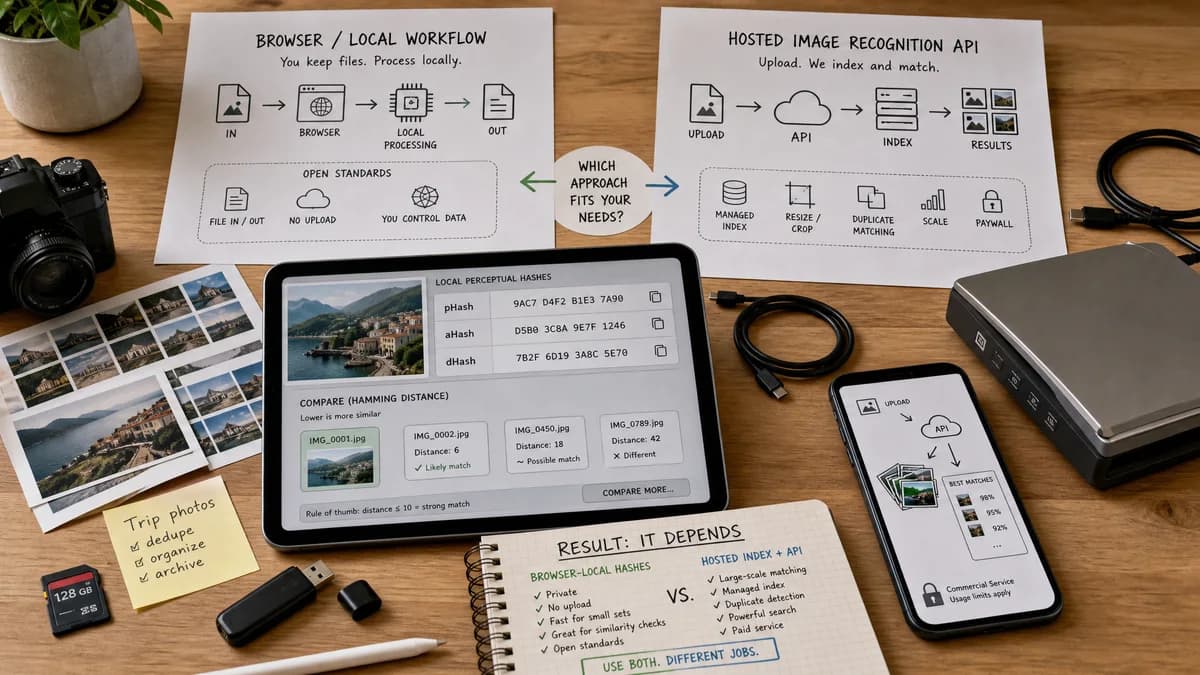
Why Perceptual Hash Generator fits
Perceptual Hash Generator gives users copy-ready pHash-style, average hash, and difference hash outputs for a single uploaded image, plus Hamming-distance guidance for comparing hashes manually or in their own systems.
What TinEye MatchEngine offers
TinEye MatchEngine is a hosted commercial API for duplicate, modified, and resized image matching across a user-managed image collection.
Open alternative signals
Workflow scope
Perceptual Hash GeneratorSingle-image hash generation and copy-ready comparison guidance
TinEye MatchEngineHosted indexed matching against a managed image collection
Data handling
Perceptual Hash GeneratorDecode and hash the uploaded image locally in the browser
TinEye MatchEngineAPI workflow that sends images or image references to a hosted service
Output style
Perceptual Hash GeneratorVisible pHash-style, average hash, difference hash, and Hamming-distance notes
TinEye MatchEngineSearch or match results from TinEye's image recognition system
Workflow fit
Perceptual Hash GeneratorBest for developers and analysts who need raw hash fingerprints
TinEye MatchEngineBest for teams needing scalable duplicate detection infrastructure
Decision guide
Quickly creating transparent image fingerprints locally for prototypes, documentation, audits, and small comparison workflows.
Running indexed search against large image collections where uploads, API integration, account setup, and image recognition infrastructure are acceptable.
Side-by-side open source alternative comparison
| Decision point | Perceptual Hash Generator | TinEye MatchEngine | Takeaway |
|---|---|---|---|
| Primary job | Our workflowGenerate perceptual hash strings from an uploaded image. | Proprietary workflowFind matching or modified images in a collection through an API. | TextFaker does not promise TinEye-scale search; it emphasizes transparent fingerprint generation. |
| Privacy model | Our workflowNo upload is needed after the page loads. | Proprietary workflowImages are submitted to a third-party recognition service. | Local processing is the clearest differentiator for sensitive samples. |
| Developer usefulness | Our workflowProvides hashes users can paste into code, spreadsheets, or tests. | Proprietary workflowProvides API search results and collection operations. | The TextFaker page targets hash inspection and lightweight comparison, not collection management. |
| Failure handling | Our workflowUnsupported files and decode errors do not count toward access usage. | Proprietary workflowAPI eligibility and request counting are governed by service terms. | Counting only successful hash generation matches the tool's user intent. |
| Expected SEO angle | Our workflowOpen-source-powered alternative for image pHash, aHash, dHash, and Hamming distance. | Proprietary workflowEnterprise image recognition and reverse-image search API. | The page ranks for hash-generation intent rather than full reverse-search intent. |
| Testing focus | Our workflowVerify deterministic hashes, copy-all output, decode errors, and paywall counting. | Proprietary workflowNo local implementation tests are available to TextFaker users. | Focused tests prove the local hashing contract. |
Detailed research
Why Users Compare Them
Users searching for MatchEngine alternatives may only need the fingerprinting part of an image-similarity workflow. A browser-local perceptual hash generator can satisfy that narrower need without account setup, hosted indexing, or API integration.
- Position TextFaker as a hash-generation utility, not a reverse image search engine.
- Include a clear note that Hamming distance is useful for comparing same-algorithm hashes, not a universal identity score.
Implementation Details
The tool decodes images locally, normalizes to deterministic grayscale sampling, and exposes pHash-style, average hash, and difference hash results. A single copy-all button includes file details, hash values, and Hamming-distance guidance.
- Use shared ToolUploadDropZone.
- Count usage only after successful hash output.
- Add focused tests for successful hashing, unsupported inputs, decode errors, and copy-ready result formatting.
SEO Content Angle
The alternative page explains when a raw perceptual hash is enough and when a commercial image-recognition API is more appropriate.
- Target searches for image pHash generator, perceptual hash generator, compare image hashes, and duplicate image detection hash.
- Avoid implying TextFaker is open source unless a public source license is proven.
Boundary With Existing Tools
This tool stays separate from image diff, color extraction, histogram, and transparency tools by focusing on similarity fingerprints rather than visual overlays, palette values, distributions, or alpha analysis.
- Do not reuse the Pixel-by-Pixel Image Diff result model.
- Do not frame pHash as an exact pixel comparison.
Research notes
- Official TinEye documentation says MatchEngine is built for finding duplicate, near-duplicate, resized, and modified images in a collection.
- TinEye describes its technology as image recognition rather than a simple public pHash/aHash/dHash calculator.
- Use this comparison to clarify that TextFaker is browser-based and open-source-powered, not a hosted proprietary software image index.
Official source
The proprietary product link is included once here for source checking after the alternative analysis.
Official TinEye MatchEngine source