
Open Source Alternatives to Kapwing
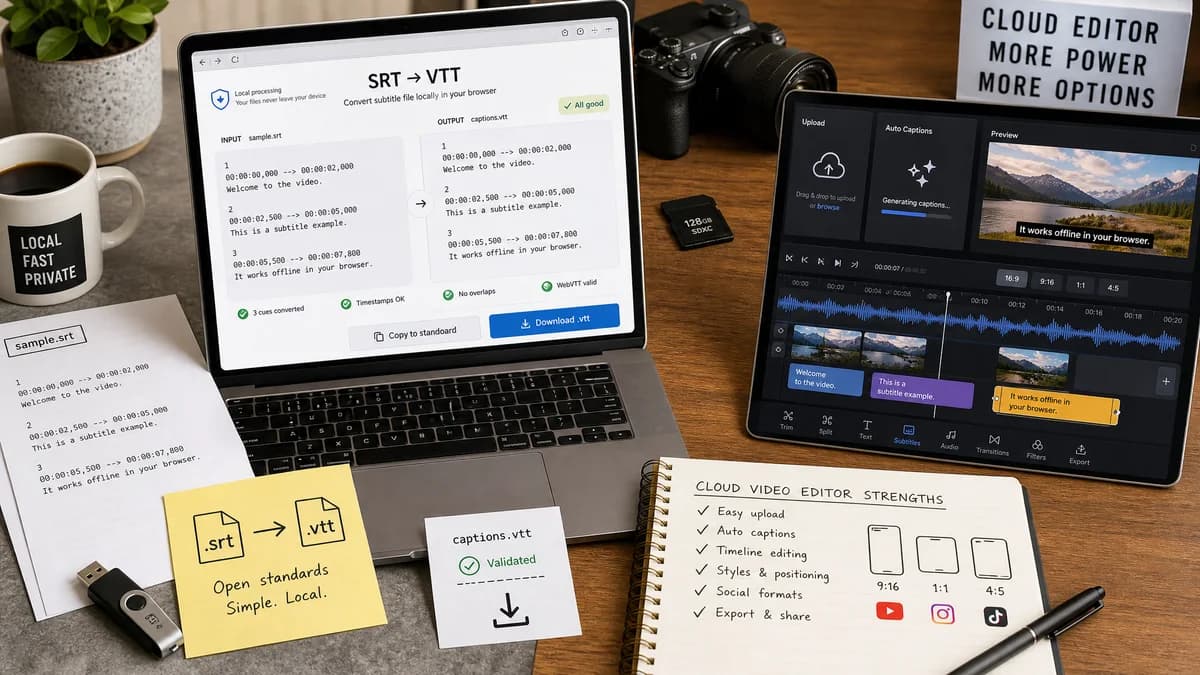
SRT to VTT Converter is a browser-based alternative for users who need this focused result without installing a proprietary desktop app or entering a larger hosted workflow.
This research compares that workflow with Kapwing while keeping the outbound source link at the bottom after the analysis.
Why SRT to VTT Converter fits
TextFaker can provide a smaller browser-local SRT to VTT converter for users who already have a subtitle file and only need deterministic format conversion, validation, copying, and download.
What Kapwing offers
Kapwing is stronger when the user wants video upload, caption generation, timeline editing, and social-video editing around the subtitle workflow.
Open alternative signals
Local processing
SRT to VTT ConverterRuns in the browser from pasted text or a selected .srt file without uploading the subtitle to a conversion service.
KapwingCloud workflow centered on uploaded files and online video editing.
Output scope
SRT to VTT ConverterFocused WebVTT text, cue count, warnings, validation state, and .vtt download.
KapwingSubtitle conversion plus caption generation, editing, and video export features.
Automation fit
SRT to VTT ConverterEasy to test with fixed SRT fixtures and exact output assertions.
KapwingMore UI and media-workflow oriented, with outputs tied to account and project behavior.
Mobile use
SRT to VTT ConverterCan expose paste, upload, copy, and download controls in a single responsive form.
KapwingMobile access depends on the broader editor experience and project flow.
Decision guide
Converting an existing .srt file to .vtt locally with visible cue counts, warnings, and a downloadable WebVTT file.
Generating captions from video, editing caption timing against a video timeline, or combining subtitle conversion with a full video project.
Side-by-side open source alternative comparison
| Decision point | SRT to VTT Converter | Kapwing | Takeaway |
|---|---|---|---|
| Privacy model | Our workflowBrowser-local text conversion can avoid sending subtitle content to a server. | Proprietary workflowKapwing is a hosted editor where files are handled by the service. | Privacy-sensitive training, client, or internal captions are a strong TextFaker angle. |
| Conversion determinism | Our workflowExact rules can be shown and tested: header insertion, timestamp normalization, blank-line cue separation, and warning messages. | Proprietary workflowKapwing abstracts conversion inside a larger editing workflow. | TextFaker can win on transparent, testable output for simple conversions. |
| Feature depth | Our workflowPurpose-built converter with validation and download. | Proprietary workflowFull video editor with auto subtitles and project tools. | Kapwing remains better for video-first caption creation. |
| Onboarding | Our workflowNo account should be required for paste-and-convert usage. | Proprietary workflowEditor workflows may introduce project, upload, or workspace steps. | A lightweight utility can serve users who only need one clean file conversion. |
| Testable outputs | Our workflowAutomated tests can assert WEBVTT prefix, cue total, normalized timestamps, warnings, and file extension. | Proprietary workflowHosted conversion output may be harder to inspect in automated TextFaker tests. | TextFaker should expose machine-checkable state in the UI. |
| Standards alignment | Our workflowCan cite and follow W3C WebVTT syntax for output validation. | Proprietary workflowKapwing supports common subtitle formats but does not need to expose every conversion rule. | Standards-first messaging supports trust for a focused tool. |
Detailed research
Demand fit
Users comparing Kapwing with a focused converter usually have an existing SRT file and need a VTT file for a web player, LMS, client portal, or publishing workflow. They may not want to upload the whole video or open a full editor just to change subtitle syntax.
- Public discussions mention converting normal SRT files to WebVTT for playback and platform compatibility.
- A privacy-focused Adobe Community question specifically asks for secure SRT to VTT conversion when the video contains proprietary information.
- Instructional-design users report that AI/manual conversion can require fiddling, especially around punctuation and timestamp formatting.
Implementation angle
TextFaker should make the conversion auditable: show the parsed cue count, the generated WebVTT size, any skipped or repaired cues, and a validation result that automated tests can verify.
- Accept pasted SRT text and .srt uploads.
- Normalize CRLF and LF line endings deterministically.
- Reject or warn on missing timestamp arrows, invalid time order, empty cue text, and duplicate or nonnumeric cue indexes.
- Emit a Blob with MIME text/vtt and a .vtt filename.
Positioning
The page should avoid claiming that TextFaker itself is open source. It can safely emphasize browser-based processing, open WebVTT standards, and an open-source-powered parsing approach if the implementation uses inspectable open libraries.
- Best headline angle: local SRT to WebVTT conversion without a full video editor.
- Best proof points: deterministic output, privacy-friendly processing, and standards-based validation.
Content risks
The tool should not imply it creates captions from audio or fixes timing against video unless those features exist. It converts existing subtitle text between closely related timed-text formats.
- Keep copy clear that SRT/VTT files are text subtitle files, not video files.
- Do not promise preservation of unsupported SRT styling beyond plain cue text unless implemented and tested.
Research notes
- Official Kapwing pages describe subtitle conversion across SRT, VTT, and TXT plus automatic subtitle extraction from common video formats.
- Public editor discussions show users ask how to convert SRT to WebVTT for compatibility, not always because they need a full video editor.
- A deterministic local implementation should parse cue indexes and SRT comma timecodes, emit WEBVTT, replace timestamp commas with dots, count cues, and warn on malformed ranges.
Official source
The proprietary product link is included once here for source checking after the alternative analysis.
Official Kapwing source