
Color Palette Generator from Image vs Scanly Color Palette Extractor
Color Palette Generator from Image is the baseline in this comparison: Upload a photo or graphic and generate a browser-local color palette with dominant swatches, HEX, RGB, HSL values, and copy/download controls.
Compare TextFaker's browser-local image palette tool with Scanly's color palette extractor.
Quick verdict
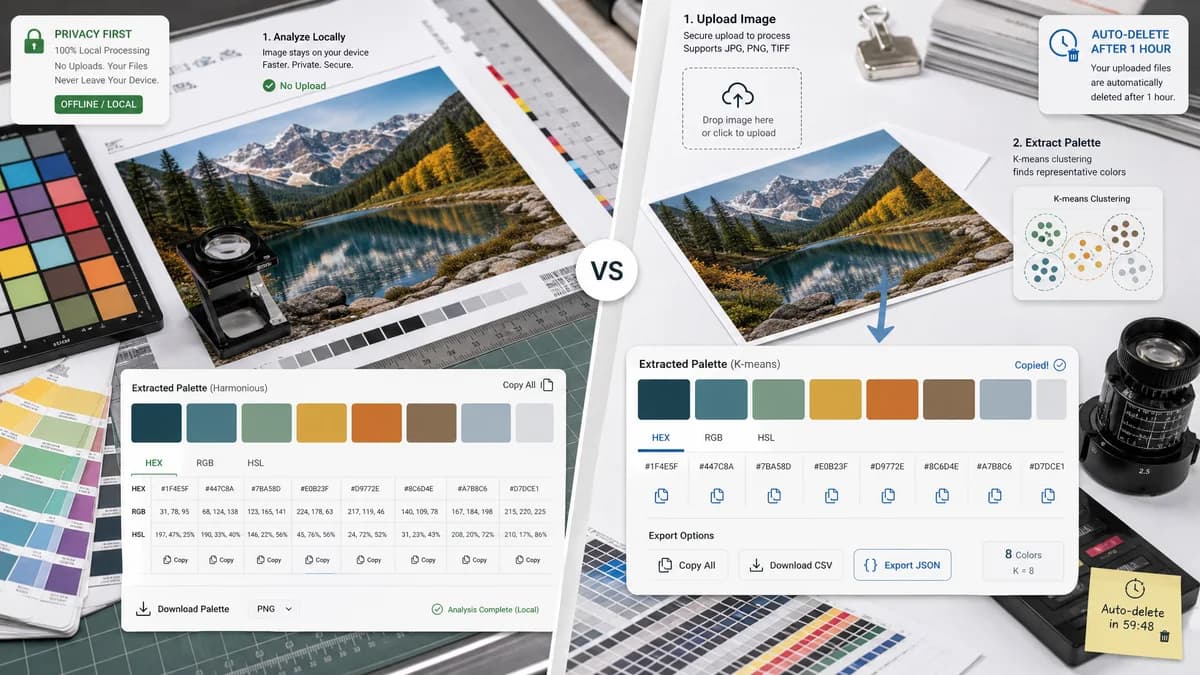
TextFaker is the better fit when users do not want any upload. Scanly is competitive for users comfortable with upload handling who want JSON export and clustering explanation.
How Color Palette Generator from Image fits
TextFaker focuses on no-upload local image analysis, harmonious swatches, HEX/RGB/HSL values, copy controls, and download options for privacy-sensitive users.
How Scanly Color Palette Extractor fits
Scanly extracts palettes from uploaded images, provides HEX/RGB/HSL, supports one-click copying and JSON export, explains k-means clustering, and says uploaded files are auto-deleted after one hour.
Side-by-side comparison
| Decision point | Color Palette Generator from Image | Scanly Color Palette Extractor | Takeaway |
|---|---|---|---|
| Image handling | Our workflowLocal browser processing with no upload. | Competitor workflowScanly allows image upload and states files auto-delete in one hour. | TextFaker is stronger for strict privacy. |
| Color formats | Our workflowHEX, RGB, and HSL. | Competitor workflowScanly also provides HEX, RGB, and HSL. | Both satisfy mainstream format needs. |
| Export | Our workflowcopy and download options. | Competitor workflowScanly advertises JSON export. | TextFaker include JSON export to match Scanly for structured output. |
| Algorithm transparency | Our workflowDocuments the real implemented extraction method. | Competitor workflowScanly explains sampling and k-means clustering. | Scanly is stronger on method explanation unless TextFaker adds accurate notes. |
| Palette guidance | Our workflowHarmonious palette framing and swatches. | Competitor workflowScanly suggests common palette sizes and explains dominant clusters. | TextFaker can combine practical guidance with a simpler UI. |
| File limits | Our workflowStates supported formats and limits once implemented. | Competitor workflowScanly lists JPG, PNG, WebP, SVG and a 50 MB max in the retrieved page summary. | Clear limits improve trust and reduce failed uploads. |
Use Color Palette Generator from Image when
- No-upload privacy requirements
- Browser-local file handling
- Simple visual swatches plus copy/download controls
- Users already using TextFaker's local image tools
Use Scanly Color Palette Extractor when
- Users who want JSON export from a simple web extractor
- People comfortable with temporary upload deletion policies
- Understanding k-means based extraction
- Quick HEX/RGB/HSL copying
Detailed comparison
Privacy Difference
Scanly is not necessarily weak on privacy, but it uses an upload-and-delete model. TextFaker's local-only model is materially different and is stated plainly.
Parity Features
Since Scanly already offers HEX, RGB, HSL, one-click copy, and JSON export, TextFaker include those basics or avoid claiming a stronger utility workflow.
- Add JSON download if practical.
- Show all three color formats.
- Let users copy individual swatches and full palettes.
Educational Copy
Scanly explains k-means clustering, which helps users trust the result. TextFaker include a concise explanation based on its actual algorithm.
User Decision
Choose TextFaker for strict local handling. Choose Scanly if JSON export and a simple upload-based extractor are acceptable.
Research notes
- Scanly's official page says it generates palettes from uploaded images with HEX, RGB, and HSL.
- Scanly advertises one-click copying and JSON export.
- Scanly states files are auto-deleted in one hour.
- Scanly explains that it uses pixel sampling and k-means clustering to group similar tones.
Official source
The only outbound competitor link on this page is placed here for source checking after the comparison.
Official Scanly Color Palette Extractor source