
Dominant Colors Extractor vs node-vibrant
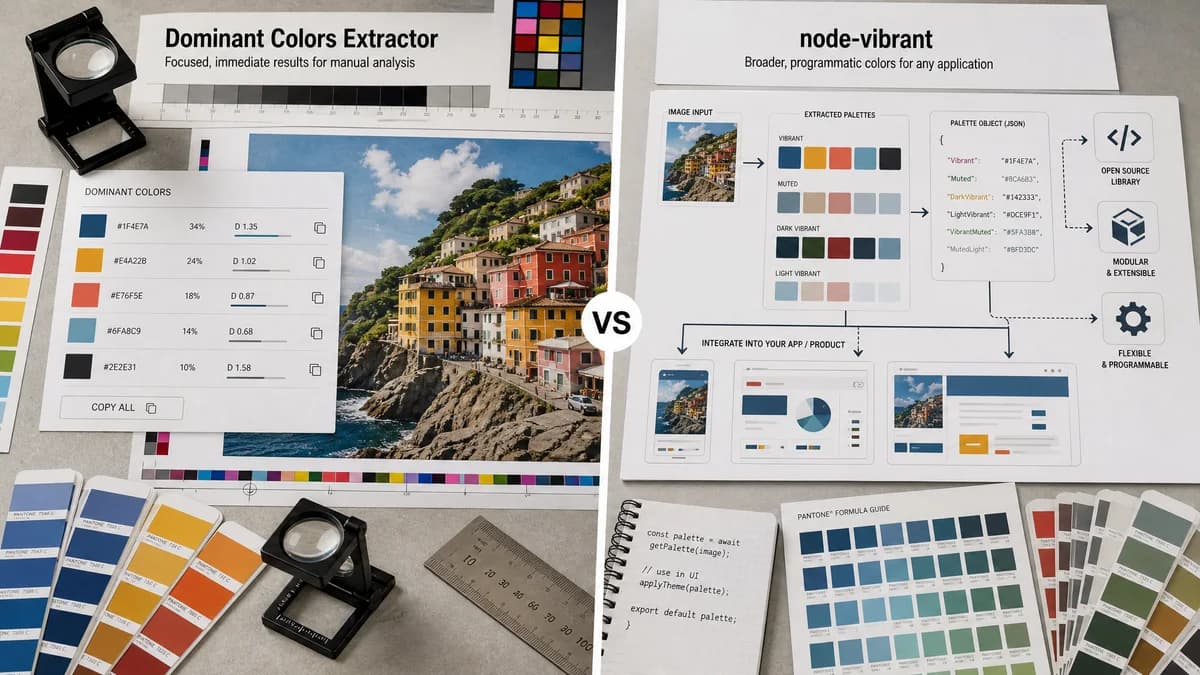
Dominant Colors Extractor is the baseline in this comparison: Upload an image and extract a ranked browser-local color palette with HEX, RGB, HSL, and percentage values without sending the file to a server.
node-vibrant is a library for extracting prominent image colors and generating aesthetically useful swatches.
Quick verdict
Choose TextFaker for manual image analysis and copyable values; choose node-vibrant for product code that needs prominent color swatches programmatically.
How Dominant Colors Extractor fits
Dominant Colors Extractor can serve users who need immediate browser results rather than a library for application code.
How node-vibrant fits
The official node-vibrant repository describes the project as extracting prominent colors from an image, continuing the Vibrant.js style of producing useful image-derived swatches for applications.
Side-by-side comparison
| Decision point | Dominant Colors Extractor | node-vibrant | Takeaway |
|---|---|---|---|
| Audience | Our workflowGeneral web users, marketers, designers, and developers doing a quick extraction. | Competitor workflowDevelopers adding color extraction to an application. | Dominant Colors Extractor can avoid developer-only language on the main page. |
| Extraction style | Our workflowDominant colors ranked by image share. | Competitor workflowProminent color extraction aimed at useful swatches rather than only coverage ranking. | Dominant Colors Extractor is explicit about dominance and percentages. |
| Setup | Our workflowOpen a web page and upload an image. | Competitor workflowUse a JavaScript package and integrate it into code. | TextFaker wins for zero setup. |
| Output presentation | Our workflowHuman-readable table with swatches, HEX, RGB, HSL, and percentages. | Competitor workflowProgrammatic return values for application logic. | Dominant Colors Extractor is better for copy-and-paste workflows. |
| Customization | Our workflowSimple UI-level settings. | Competitor workflowLibrary behavior can be configured inside code and composed with other tooling. | node-vibrant is better for custom applications. |
| Privacy model | Our workflowBrowser-local no-upload extraction for local files. | Competitor workflowPrivacy depends on how the consuming application handles images. | Dominant Colors Extractor can make privacy predictable for end users. |
Use Dominant Colors Extractor when
- No-code image upload workflow
- Percentage-ranked dominant colors
- Immediate HEX/RGB/HSL copying
- Privacy-forward end-user tool pages
Use node-vibrant when
- Developers building adaptive UI color features
- Applications needing programmatic swatches
- Projects that want Vibrant-style semantic colors
- Node or JavaScript integration
Detailed comparison
Adjacent Competitor
node-vibrant is not a direct online-tool competitor, but it competes for developers who might otherwise build or embed extraction rather than use TextFaker.
- Position TextFaker as the fastest way to inspect an image manually.
- Offer export formats that developers can paste into code.
Dominant vs Prominent
Prominent color libraries often choose useful, vibrant, or muted swatches. Dominant Colors Extractor's SEO promise stays anchored to dominant colors and percentages.
Product Scope
Dominant Colors Extractor can not expose library complexity unless a setting maps clearly to user intent.
Research Notes
The official repository title and description identify node-vibrant as a tool for extracting prominent colors from an image.
Research notes
- node-vibrant is a real open-source adjacent tool for image color extraction.
- It is best treated as a developer-library comparison, not a consumer web-app comparison.
- TextFaker's advantage is packaging the extraction task into a usable no-code page.
Official source
The only outbound competitor link on this page is placed here for source checking after the comparison.
Official node-vibrant source