
PNG to WebP Converter vs Squoosh
PNG to WebP Converter is the baseline in this comparison: Convert PNG images to WebP locally with image/webp output checks, .webp filenames, preserved dimensions, transparency handling, and adjustable quality.
Squoosh is a browser-based image optimizer for compressing and comparing images with different codecs.
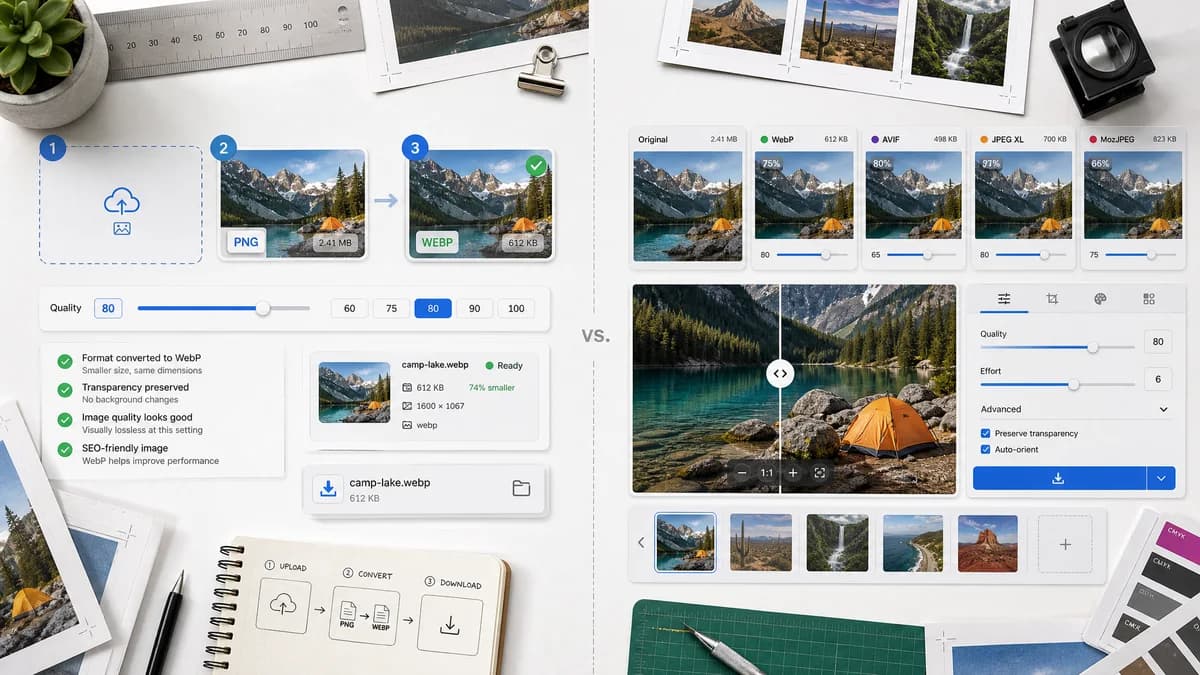
Quick verdict
TextFaker be preferred for a fast exact PNG-to-WebP task with SEO-friendly guidance and simple verification. Squoosh is better for codec experimentation and visual comparison.
How PNG to WebP Converter fits
TextFaker be less experimental and more task-specific: upload a PNG, choose WebP quality, validate the generated WebP output, and download it with predictable text and filename.
How Squoosh fits
Squoosh is powerful for visual codec comparison and local optimization. It is broader than a single PNG-to-WebP converter and is better for users who want side-by-side codec tuning.
Side-by-side comparison
| Decision point | PNG to WebP Converter | Squoosh | Takeaway |
|---|---|---|---|
| Product shape | Our workflowDedicated PNG to WebP converter route. | Competitor workflowFull image optimizer and codec comparison application. | TextFaker reduce choices for exact-intent users. |
| Processing location | Our workflowBrowser-local conversion. | Competitor workflowBrowser-local optimization. | Privacy is a parity point, not a differentiator against Squoosh. |
| Validation | Our workflowExplicit output MIME, filename, dimensions, Blob, and transparency checks. | Competitor workflowVisual optimization and codec output controls are central. | TextFaker differentiate by showing file-level proof. |
| Quality control | Our workflowOne WebP quality slider aligned to the dedicated task. | Competitor workflowCodec-specific controls for comparing outputs. | Squoosh is more flexible; TextFaker is simpler. |
| SEO page | Our workflowDedicated SEO page/config for PNG to WebP conversion only. | Competitor workflowSingle application landing around image compression and codecs. | TextFaker can answer the exact search intent more directly. |
| Open-source relevance | Our workflowCan cite Squoosh as an open-source browser-local benchmark, while using existing TextFaker internals. | Competitor workflowSource is available and demonstrates mature local codec workflows. | Squoosh is both a competitor and a technical precedent. |
Use PNG to WebP Converter when
- Users who know they need WebP output
- Simple PNG to WebP conversion with validation
- Repeatable download/copy text in a dedicated converter UI
Use Squoosh when
- Codec comparison and image optimization experiments
- Users tuning multiple codecs visually
- Open-source browser-based optimization workflows
Detailed comparison
Closest Local Benchmark
Squoosh is the closest privacy-model benchmark because it also runs in the browser. TextFaker's distinction is a narrower conversion task with less codec UI.
UX Simplicity
Users searching for PNG to WebP may not want to learn codec comparison. TextFaker keep the first screen focused on input, quality, result facts, and download.
Validation Layer
Squoosh emphasizes visual optimization; TextFaker can emphasize file validity. The result panel confirms that the output object is a WebP Blob and not just a preview.
Open Source Alternative Data
Squoosh also belongs in open-source alternatives because it is an open browser image optimizer with source available. It is a useful reference for browser-local expectations.
Research notes
- Squoosh states that images never leave the device and that it compresses and compares images with different codecs.
- Because Squoosh is browser-local, TextFaker not overstate privacy differentiation against it.
- TextFaker can still be easier for exact PNG to WebP intent because it avoids broad codec comparison UI.
Official source
The only outbound competitor link on this page is placed here for source checking after the comparison.
Official Squoosh source